

A small candle business posts a 20-second video of pouring wax into a mold. No fancy lighting. No script. Just a phone propped on a shelf. It gets 4.7 million views overnight. Orders crash the website.
This happens on TikTok every week. Not to big brands with ad budgets. To small e-commerce stores run by one or two people.
Key Takeaways
- TikTok’s algorithm favors small creators: Follower count doesn’t matter. Engagement does.
- Authentic content wins: Unpolished, behind-the-scenes videos outperform studio-quality ads.
- Short-form video sells products: 73% of TikTok users say they feel a deeper connection to brands they discover on the platform.
- You don’t need to go viral to profit: Consistent posting to a niche audience builds steady, compounding revenue.
Why TikTok is different for small e-commerce stores
Instagram rewards accounts that already have a following. Facebook’s organic reach is nearly dead. Pinterest is slow and steady. TikTok is the only major platform where a zero-follower account can reach millions of people with a single post.
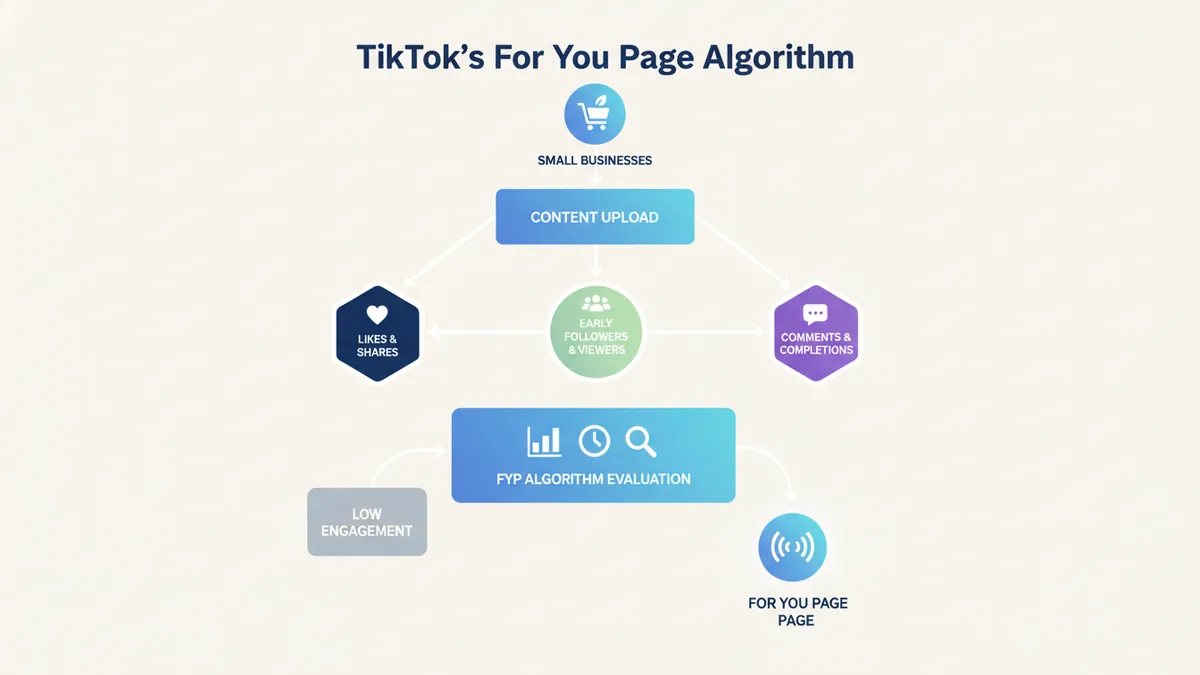
The reason is the For You Page (FYP). Unlike other platforms that show you content from people you follow, TikTok’s FYP is driven entirely by content performance. Every video gets pushed to a small test audience first. If those people watch, like, comment, and share, TikTok pushes it to a bigger audience. Then a bigger one. Then a bigger one.
This means the playing field is genuinely level. A one-person Shopify store has the same shot at reaching a million people as Nike does.
How the TikTok algorithm actually works
Understanding the algorithm is the difference between posting into the void and getting your products in front of the right people.
What TikTok measures
TikTok ranks every video based on these signals, in roughly this order of importance:
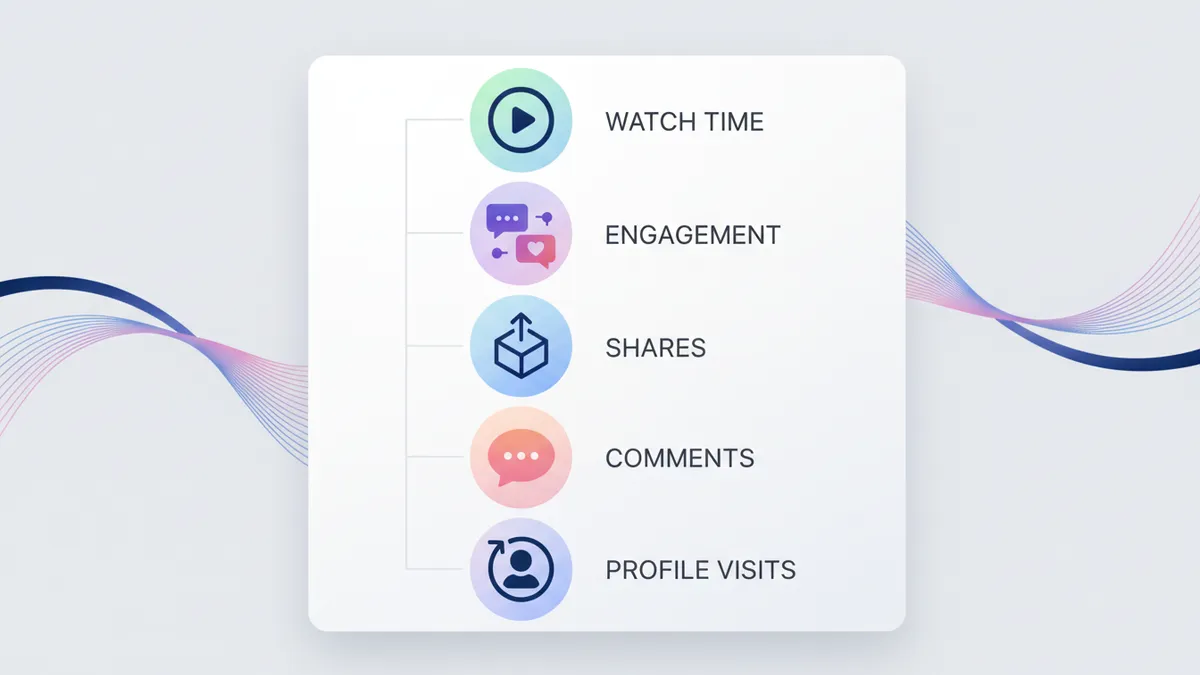
- Watch time and completion rate. Did people watch the whole video? Did they watch it twice? This is the strongest signal.
- Engagement velocity. How quickly do likes, comments, shares, and saves happen after posting?
- Shares. A share is the most valuable action. It tells TikTok your content is worth passing along.
- Comments. Videos that spark conversation get pushed further. Length of comments matters too.
- Profile visits after watching. If someone watches your video and then visits your profile, TikTok knows the content created interest.
Why this favors small stores
Big brands create polished ads. TikTok users scroll past polished ads. They stop for content that feels real. A video of you packing orders at your kitchen table, talking about your day, showing your product in natural light. That is the content TikTok rewards.
Small stores also have something big brands can’t fake: a personal story. “I started this in my apartment with $200” hits different than “Introducing our new collection.” TikTok users root for small businesses.
TikTok content that drives sales for small stores
Not every viral video leads to sales. The formats below consistently turn views into revenue.

1. Behind-the-scenes and “pack an order” videos
This is the most reliably viral content format for small e-commerce stores. People love watching the process.
What works:
- Packing orders with satisfying ASMR sounds
- Showing your workspace or studio
- Demonstrating how products are made
- Walking through your morning routine as a business owner
- Reacting to a big order coming in
The appeal is voyeuristic and aspirational. People feel like they are part of your journey. They buy because they want to support you, not just because they need the product.
2. Product demos in real life
Forget flat-lay product photos. On TikTok, show your product being used in a real setting. Need ideas? Here’s how to turn product photos into scroll-stopping social content across multiple formats.
Examples by niche:
- Skincare: Applying the product, showing texture, doing a 7-day transformation
- Home decor: Styling a room, showing before/after
- Jewelry: Close-up try-ons with outfit pairings
- Food: Cooking with the product, taste reactions
- Apparel: Getting-ready-with-me (GRWM) styling videos
The key: show the product in context, not isolation. People need to imagine owning it.
3. Customer reaction and unboxing videos
Social proof is powerful on any platform. On TikTok, it’s supercharged because authentic reactions feel genuine in video format.
How to get these:
- Include a card in your packaging asking customers to tag you on TikTok
- Offer a 10-15% discount on the next order for a video review
- Repost the best customer videos with a stitch or duet
- Create a branded hashtag for customers to use
One strong customer unboxing video can outperform anything you create yourself.
4. Storytelling and founder content
TikTok users connect with people, not logos. Share your story.
Content ideas:
- Why you started your business
- Your biggest failure and what you learned
- How much it actually costs to run your store
- A day in the life of a small business owner
- Milestones (first sale, 100th order, first viral video)
Be honest. Vulnerability performs incredibly well on TikTok. A video about struggling to get your first 10 sales will resonate more than a highlight reel.
5. Trending sounds with a product twist
TikTok trends move fast. You don’t need to chase every trend, but adapting popular sounds and formats to showcase your product is a proven strategy.
Framework:
- Scroll your FYP for 15 minutes and note trending audio
- Ask: “Can I use this sound to show my product in a creative way?”
- If yes, film it quickly. Speed matters with trends.
- If you can’t make it work naturally, skip it. Forced trend content backfires.
The stores that go viral with trends usually add a genuine twist that connects the trend to their product or niche.
Setting up TikTok for your e-commerce store
Before you start posting, get the basics right.
Optimize your profile
- Username: Your brand name. Keep it simple and searchable.
- Bio: One sentence about what you sell. Include a value proposition. Example: “Handmade soy candles. Small batch, big vibes.”
- Profile photo: Your logo or a high-quality product image.
- Link: Point to your Shopify store. Use a link-in-bio tool if you need to direct to multiple pages.
TikTok Shop vs. bio link
TikTok Shop lets customers buy without leaving the app. It reduces friction and can boost conversions significantly. If you’re eligible, it’s worth setting up.
But you don’t need TikTok Shop to sell on TikTok. Many small stores drive thousands in revenue just by directing viewers to their Shopify store through their bio link and strong CTAs in videos.
Film with what you have
You don’t need a ring light, a gimbal, or a $1,000 camera. Some of the best-performing e-commerce TikToks are filmed on a phone propped against a water bottle. Good lighting (a window works), clear audio, and authentic delivery matter more than production value.
A weekly TikTok posting framework
Consistency beats virality. Most stores that “go viral” posted consistently for weeks or months before a video took off. Here’s a framework to keep you going.
Posting cadence: 4-5 videos per week
| Day | Content Type | Example |
|---|---|---|
| Monday | Behind-the-scenes | Packing orders from the weekend |
| Tuesday | Product demo | Showing your best-seller in use |
| Wednesday | Trending sound + product | Adapt a trending audio to your niche |
| Thursday | Storytelling/founder | Share a lesson or milestone |
| Friday | Customer UGC or repost | Feature a customer review or unboxing |
Batch creation tips
Don’t film one video per day. Set aside 1-2 hours per week to film all your TikToks in one session.
- Plan (15 min): Write down 5 video concepts for the week.
- Film (45 min): Record all 5 videos back-to-back. Change outfits or angles between takes.
- Edit (30 min): Add text overlays, trending sounds, and captions.
- Schedule (10 min): Queue them up for the week.
If you’re already managing Instagram and other platforms, a tool like IDEQO can help you plan your content calendar across all platforms from one dashboard. That way TikTok doesn’t become one more thing you have to remember.
How to go from views to sales
Views are exciting. Revenue is better. Here’s how to convert TikTok attention into actual orders.
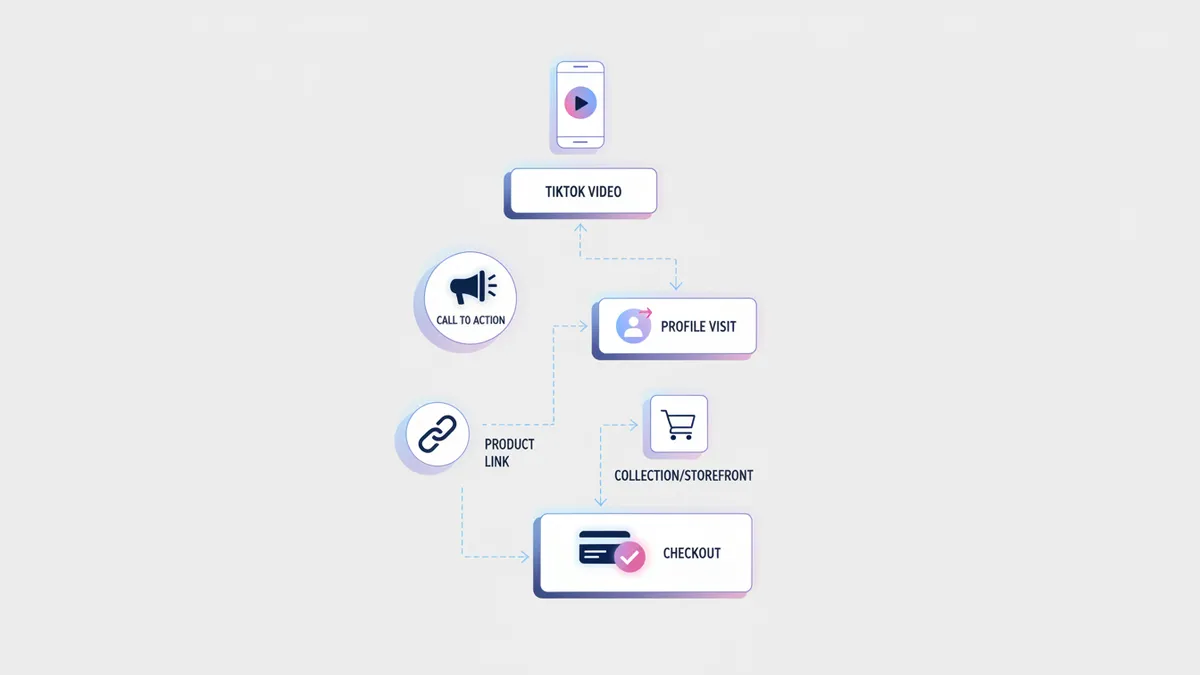
Optimize the path from video to checkout
- Strong CTA in every video. Say it out loud: “Link in bio to shop” or “Comment LINK and I’ll send it to you.” Don’t assume people know where to buy.
- Pin a shopping-related video to your profile. When someone visits your profile after seeing a viral video, the pinned video should direct them to your store.
- Link directly to the product page, not your homepage. Reduce clicks between interest and purchase.
- Use urgency when genuine. “Only 12 left” or “This batch sells out every time” works when it’s true.
Retarget TikTok viewers
Install the TikTok Pixel on your Shopify store. This lets you:
- Track which TikTok traffic converts
- Build retargeting audiences for TikTok ads
- Create lookalike audiences based on your best customers
Even if you’re not running paid ads yet, install the pixel now. You’re building a data asset that becomes valuable later.
What not to do on TikTok
Don’t post like an ad. TikTok users have zero tolerance for content that feels like a commercial. If your video could run as a TV ad, it won’t work on TikTok.
Don’t ignore comments. Reply to comments on your videos, especially in the first hour. Comments boost the algorithm, and replying to comments with a video is one of the best engagement hacks on TikTok.
Don’t wait for perfection. The stores that succeed on TikTok post frequently and let the algorithm decide what works. Your fifth video will be better than your first. Your fiftieth will be much better than your fifth. Start now.
Don’t copy other brands exactly. Get inspired, yes. But your audience follows you for your perspective. Add your own spin.
Don’t treat TikTok like Instagram. What works on Instagram (polished carousels, curated feeds, aesthetic grids) doesn’t translate to TikTok. TikTok rewards raw, fast, personality-driven content. If you’re already active on Instagram, check out how the strategies differ for Shopify stores.
Measuring TikTok success for your store
Track these metrics weekly:
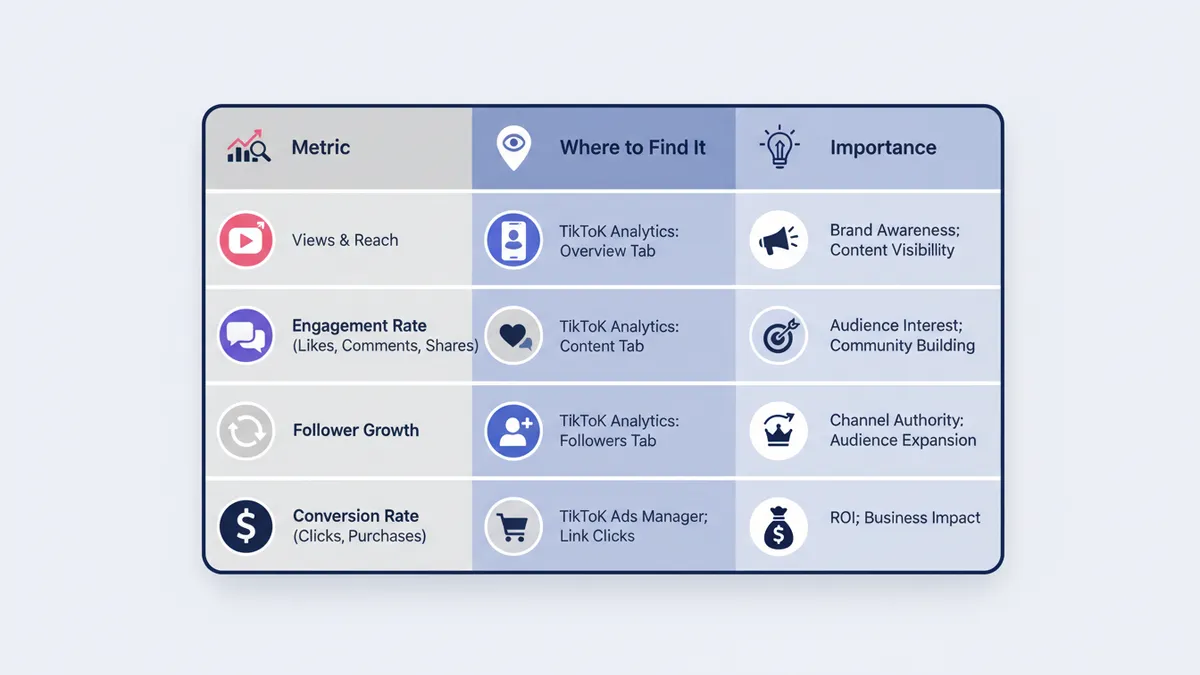
| Metric | Where to Find It | Why It Matters |
|---|---|---|
| Video views | TikTok Analytics | Top-of-funnel reach |
| Average watch time | TikTok Analytics | Content quality signal |
| Profile visits | TikTok Analytics | Interest in your brand, not just the video |
| Link clicks | Link-in-bio tool analytics | Purchase intent |
| Revenue from TikTok | Shopify “Sales by traffic source” | The metric that matters most |
Don’t obsess over views. A video with 10,000 views and 200 link clicks is more valuable than one with 500,000 views and 50 clicks.
For a broader look at measuring social media performance across platforms, see our complete social media strategy guide.
Start posting this week
You don’t need to go viral to make TikTok work for your e-commerce store. You need to show up consistently with authentic content that connects your product to real people.
Start with three videos this week:
- A behind-the-scenes video of your workspace or packing orders.
- A product demo showing your best-seller in action.
- A founder story about why you started your store.
Film them on your phone. Don’t overthink it. Post them. See what happens.
The small stores winning on TikTok aren’t the ones with the best cameras or the biggest budgets. They’re the ones that pressed record and hit publish.
Ready to plan your TikTok content alongside Instagram, Pinterest, and more? Start free with IDEQO and manage all your social content from one dashboard. Free plan available. No credit card required.
Frequently Asked Questions
Can a small e-commerce store actually go viral on TikTok?
Yes. TikTok's algorithm distributes content based on engagement, not follower count. A brand-new account can get millions of views if the content resonates. Small stores go viral regularly because TikTok rewards authentic, relatable content over polished brand campaigns.
How often should an e-commerce store post on TikTok?
Aim for 3-5 videos per week minimum. TikTok rewards consistency and volume. The more you post, the more data the algorithm has to find your audience. Many stores that go viral post daily for several weeks before a video takes off.
What type of TikTok content sells the most for small stores?
Behind-the-scenes content (packing orders, making products), product demos in real-life settings, customer reaction videos, and 'day in the life' of a small business owner consistently drive the most sales. Authenticity outperforms polish on TikTok.
Do I need TikTok Shop to sell products on TikTok?
No. You can drive traffic to your Shopify store using your bio link, link stickers in Stories, and strong calls-to-action in your videos. TikTok Shop adds in-app checkout which reduces friction, but many small stores succeed without it.
How long should TikTok videos be for e-commerce?
15-45 seconds is the sweet spot for most e-commerce content. Short enough to hold attention, long enough to tell a story. Product reveals work at 7-15 seconds. Tutorials and behind-the-scenes content can run 30-60 seconds. Watch your analytics to see what length your audience prefers.