

Ecommerce social media marketing isn’t optional anymore. It’s where your customers discover, evaluate, and connect with your brand before they ever visit your store. But 2026 looks very different from even a year ago — and if you’re running your Shopify store without a dedicated marketing team, you need a strategy that’s efficient, not just effective.
Key Takeaways
- Authenticity wins: Algorithms penalize polished, generic content. Lo-fi and candid performs better.
- Short-form video is table stakes: Reels, TikToks, and Shorts are the primary content format.
- Social is now search: Captions and alt text appear in Google results. Optimize for discovery.
- Content pillars: Stick to 3-5 themes for consistency and variety.
- AI-assisted, human-refined: Nearly 90% of marketers use AI daily, but audiences reject low-effort output.
AI content saturation, short-form video dominance, and algorithm shifts toward authentic engagement have rewritten the playbook. This guide walks you through building a strategy that works in the current landscape.
Why your old strategy won’t work in 2026
The biggest shifts this year:

- AI content saturation. Nearly 90% of marketers now use AI daily. The bar for standing out has risen dramatically. Only 26% of consumers prefer AI-generated content over human-created content.
- Algorithms reward authenticity. Instagram, TikTok, and LinkedIn all penalize overly polished, generic content. Lo-fi, candid posts and creator-led storytelling outperform brand campaigns. Polish is out.
- Micro-behaviors drive distribution. Algorithms no longer rely on likes and comments alone. Platforms track hover time, rewatches, pauses, and scroll speed to decide what gets pushed.
- Short-form video is the default. Reels, TikToks, and YouTube Shorts aren’t experimental. They’re the primary content format across every major platform.
- Social media is a search engine. Content now appears in Google results. Captions, subtitles, alt text, and Q&A-style posts all improve discoverability.
- Community beats follower count. Brands with smaller, engaged communities outperform those with large, passive followings.
- Copy-paste is dead. Consumers expect platform-specific content. Reposting the same thing across Instagram, LinkedIn, and TikTok no longer works.
Step 1: Audit your current presence
Before building forward, understand where you stand.
- Platform performance. Which platforms drive actual business results? Traffic, leads, sales. Not vanity metrics.
- Content performance. What types of posts get the most engagement? Look at saves and shares, not just likes. Instagram saves and shares are the strongest quality signals.
- Audience demographics. Has your audience shifted platforms? Check where they actually spend time now.
- Competitor analysis. What’s working for competitors? What gaps exist?
- Search visibility. Are your social posts appearing in search results? Check if your captions and alt text are optimized for discovery.
Use IDEQO’s Analytics dashboard to pull cross-platform performance data into one view.
Step 2: Define your content pillars
Content pillars are 3-5 recurring themes that anchor your content calendar. They ensure variety while keeping your brand consistent.
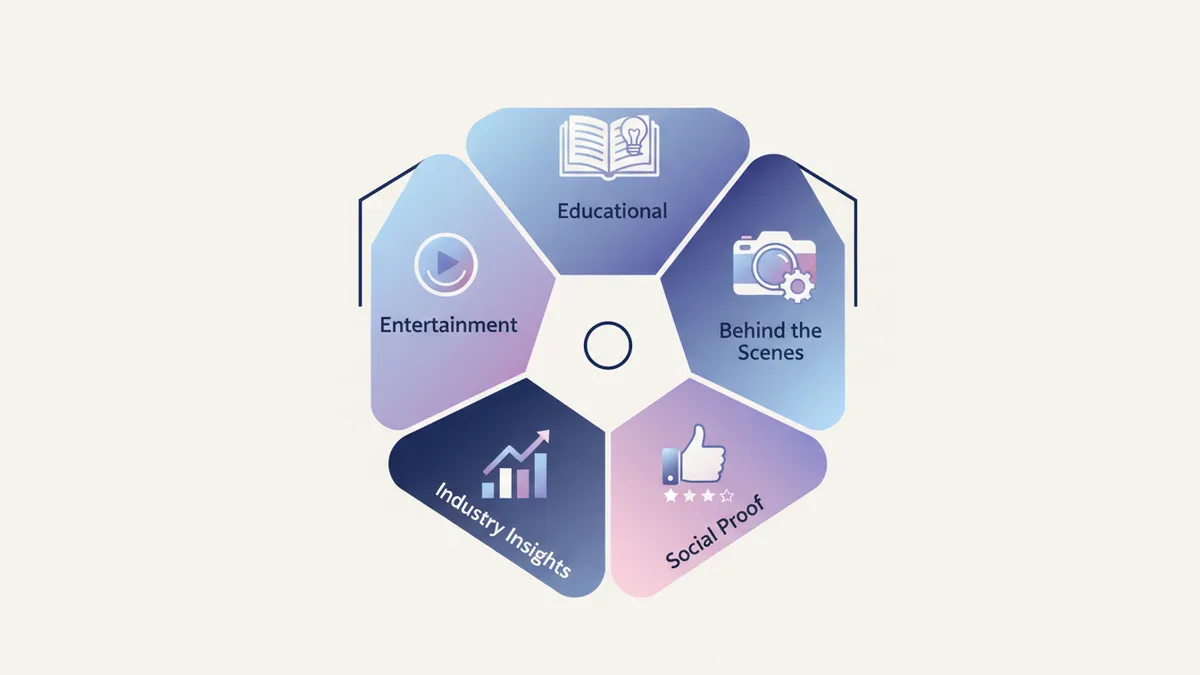
Example content pillars for an e-commerce brand:
| Pillar | Content Types | Goal |
|---|---|---|
| Educational | How-tos, tips, tutorials | Build authority |
| Behind the scenes | Team stories, process reveals | Build trust |
| Social proof | Reviews, testimonials, UGC | Drive conversions |
| Industry insights | Trends, data, predictions | Thought leadership |
| Entertainment | Memes, relatable content, trends | Increase reach |
Not sure how to plan this out week by week? Our guide on building a social media content calendar breaks it down step by step.
Step 3: Choose your platforms strategically
Not every brand needs to be on every platform. Pick 2-3 where your audience spends time and where the format matches your strengths.

Platform decision framework
- Instagram. Visual brands, lifestyle, e-commerce, B2C. Strong for carousels and Reels. Engagement benchmark: 3-6%.
- TikTok. Younger demographics, entertainment, education, rapid growth potential for small stores. Engagement benchmark: 4-8%.
- LinkedIn. B2B, professional services, thought leadership, recruiting. Comment quality weighs more than reactions. Engagement benchmark: 2-4%.
- YouTube. Long-form education, tutorials, vlogs. Strong SEO benefits since Google owns it.
- Pinterest. E-commerce, home, fashion, food, DIY. High purchase intent traffic.
- X (Twitter). Tech, news, real-time conversation, B2B. Engagement benchmark: 0.5-1%.
Go deep on your chosen platforms. Create content specifically for each one. The days of posting identical content everywhere are over.
Step 4: Build your content calendar
A content calendar eliminates the “what should I post today?” panic. Plan at least 2 weeks ahead. Batch-create in sprints.
Weekly content framework:
- Monday. Educational post (tip or how-to)
- Tuesday. Behind-the-scenes or team highlight
- Wednesday. Carousel or long-form content
- Thursday. Engagement post (poll, question, discussion)
- Friday. User-generated content or testimonial
Posting frequency by platform (2026 data)
| Platform | Recommended Frequency | Notes |
|---|---|---|
| 3-5 posts per week | Consistency correlates directly with reach growth | |
| TikTok | 2-5 posts per week | 6-9 PM Tue-Thu performs best |
| 2-5 posts per week | 7-9 AM and 12-1 PM Tue-Wed peak | |
| X | 3-5 posts per week | Real-time conversation adds to this |
| 3-5 posts per week | Groups can supplement feed posts |
The research is clear: creators who post regularly for 20+ weeks achieve around 450% more engagement per post compared to sporadic posting. You don’t need a perfect schedule. You need a sustainable rhythm.
Use IDEQO’s Content Calendar to plan, visualize, and schedule across all platforms from one dashboard.
Step 5: Optimize for social search
This is the trend most brands are sleeping on. Social media posts now appear in Google search results. TikTok and Instagram have their own robust search features. Your content strategy needs to account for this.

How to optimize:
- Write captions like mini blog posts. Include keywords your audience searches for.
- Add descriptive alt text to every image. It helps accessibility and search.
- Use question-and-answer formats. These surface in both platform search and Google.
- Add subtitles to all video content. Platforms index the text.
- Think about search intent, not just scroll-stopping hooks.
This doesn’t mean stuffing keywords into every caption. Write naturally, but be specific. “5 ways to style a white tee” performs better in search than “outfit inspo.” For a deep dive on keyword strategy for your store, see our e-commerce keyword research guide.
Step 6: Leverage AI without losing authenticity
AI is a tool, not a replacement for your brand voice. Nearly 90% of marketers use AI daily in 2026, which means AI-generated content is everywhere. Standing out requires human perspective.
Use AI for:
- Ideation. Generate 20 post ideas in seconds, then curate the best ones.
- First drafts. Let AI write the initial copy, then edit with your brand voice.
- Repurposing. Turn a blog post into social posts, carousels, and video scripts.
- Analytics. AI can spot patterns in your performance data faster than manual review.
The key: AI-assisted, human-refined. Only 26% of consumers prefer AI-generated content over traditional creator content. Your audience can tell the difference. Add your perspective, your stories, and your imperfections. That’s what builds trust.
For a deeper dive on using AI without losing your voice, read our complete AI content creation guide.
Step 7: Measure what matters
Stop tracking vanity metrics. Here’s what actually signals performance in 2026:

| Metric | Why It Matters | Good Benchmark |
|---|---|---|
| Engagement rate | Are people interacting? | Instagram 3-6%, TikTok 4-8%, LinkedIn 2-4% |
| Save rate | Are people bookmarking? Strongest value signal | Track trend over time |
| Share rate | Are people sharing? Strongest organic growth signal | Track trend over time |
| Click-through rate | Is content driving action? | Depends on CTA placement |
| Comment-to-like ratio | Deep engagement vs. passive scrolling | Higher = better |
| Reach-to-impression ratio | Is your audience expanding? | 0.7+ is healthy |
Platforms now weight saves and shares more heavily than likes in their algorithms. If your content gets saved, it gets pushed to more people. If it gets shared, even more.
Review your metrics monthly. Adjust your content pillars and posting strategy based on what the data shows, not what feels right.
Key takeaways
- Audit before you build. Understand what’s working before changing everything.
- Content pillars keep you consistent without being repetitive.
- Choose 2-3 platforms and go deep. Platform-specific content wins.
- Social is search now. Optimize your captions and alt text for discovery.
- Use AI for efficiency, but keep your human voice. Audiences reject low-effort AI output.
- Measure saves and shares, not just likes. They drive algorithmic distribution.
Your social media strategy should evolve quarterly. Set calendar reminders to review performance and adjust your approach.
Ready to build your strategy?
IDEQO helps you plan, create, and schedule content across every platform from one dashboard. Your Brand Kit keeps everything on-brand. Your Content Calendar keeps you consistent. And AI-assisted tools help you produce more without burning out.
Start free with IDEQO. Free plan available. No credit card required.
Frequently Asked Questions
What is the best social media marketing strategy for e-commerce stores?
Focus on 2-3 platforms where your customers shop and browse. Use content pillars (product, educational, UGC, brand story) for consistency. Leverage AI tools for first drafts, then edit for your brand voice. Prioritize community engagement over follower count. Start with a content calendar and batch-create content weekly.
How often should e-commerce stores post on social media?
Optimal frequency for e-commerce is: Instagram 3-5 posts per week plus daily Stories, TikTok 3-7 videos per week, Pinterest 5-15 pins per week, and Facebook 3-5 posts per week. Consistency matters more than volume. Regular posting delivers up to 5x more engagement for online stores.
What social media platforms drive the most sales for e-commerce?
Instagram and TikTok dominate for visual e-commerce products like fashion, beauty, and home decor. Pinterest drives high-intent, evergreen traffic to Shopify stores. Facebook works best for 35+ demographics and products that need explanation. Choose based on where your customers browse and buy.
How can e-commerce stores use AI for social media content?
AI is now table stakes, with nearly 90% of marketers using it daily. For e-commerce, use AI to generate product captions, create content calendars, and repurpose one piece of content across platforms. The winning approach is AI-assisted, human-refined. Always edit for your brand voice before publishing.
What social media metrics matter most for e-commerce stores?
Focus on revenue-driving metrics: click-through rate to your store, add-to-cart rate from social traffic, and revenue per platform. For content health, track engagement rate, save rate, and share rate. Good benchmarks: Instagram 3-6% engagement, TikTok 4-8%. Stop tracking follower count as a primary metric.