

You’re not going to outrank Amazon for “running shoes.” You’re not going to beat Target for “scented candles.” And that’s fine. You don’t need to.
Key Takeaways
- Long-tail keywords convert 2-3x higher than short-tail keywords because the searcher knows exactly what they want.
- Small stores can outrank big retailers on specific, niche queries that large sites don’t bother optimizing for.
- One product page can rank for dozens of long-tail keywords if the description is comprehensive and covers multiple use cases.
- Your customers’ language is your keyword goldmine. The words in reviews, support emails, and search queries are the exact phrases to target.
- Long-tail keywords compound. 50 keywords at 30 searches each equals 1,500 free visitors per month.
Why long-tail keywords are the great equalizer
Search traffic follows a power law. A tiny percentage of keywords account for most total searches. “Running shoes” gets 300,000 searches per month. “Minimalist barefoot trail running shoes for women wide toe box” gets 90. But here’s the thing.
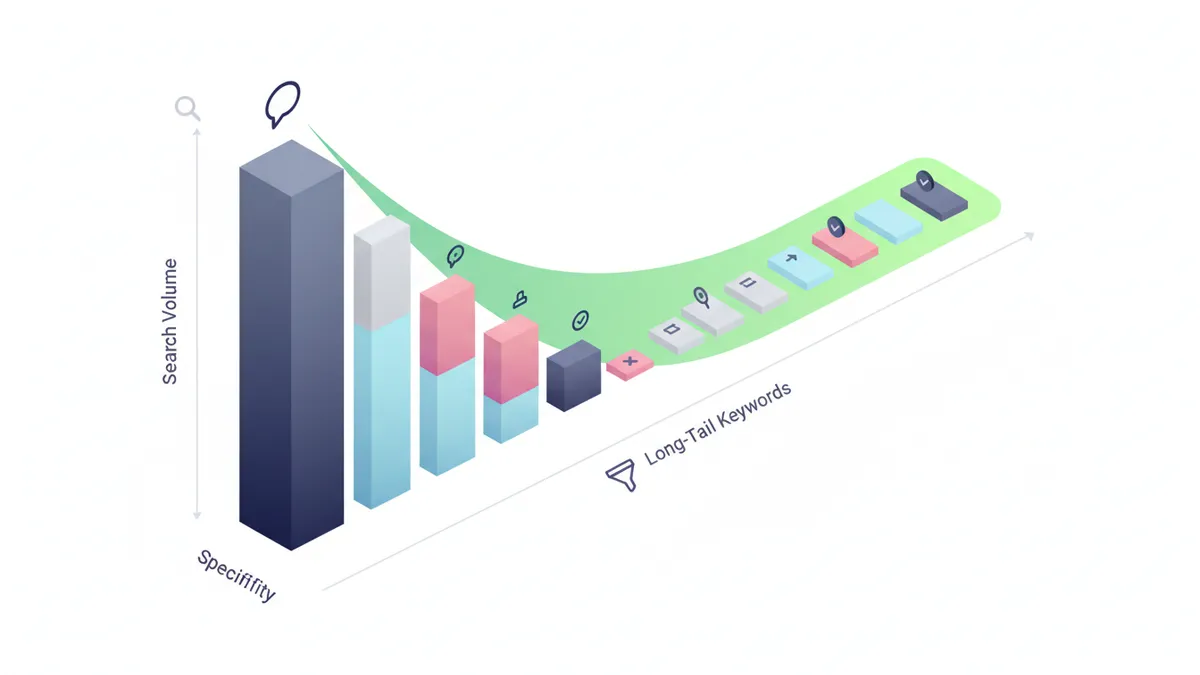
The 90-search keyword converts at 8-12%. The 300,000-search keyword converts at under 1%. And the 90-search keyword has almost no competition.
Long-tail keywords work for niche Shopify stores because they represent the long tail of search demand. No single keyword brings massive traffic. But hundreds of specific, high-intent keywords together build a substantial traffic base.
A niche shoe store targeting 200 long-tail keywords at 50 searches each equals 10,000 monthly visitors. All free. All with high purchase intent. All from people who know exactly what they want and are ready to buy.
What makes a keyword “long-tail”
Long-tail keywords have three characteristics:
1. They’re specific. Three or more words. They describe exactly what the person wants.
| Short-Tail | Long-Tail |
|---|---|
| candles | hand-poured soy candles for relaxation |
| wallet | slim front pocket wallet for men leather |
| earrings | gold huggie hoop earrings hypoallergenic |
2. They have lower search volume. Typically 10-500 monthly searches per keyword. This scares off most stores. It shouldn’t.
3. They have higher intent. The more specific the search, the closer the person is to buying. Someone searching “candles” is browsing. Someone searching “hand-poured soy candle lavender 8oz free shipping” is pulling out their credit card.
How to find long-tail keywords for your store
Finding long-tail keywords doesn’t require expensive tools. Here are five methods that work.
1. Google Autocomplete alphabet method
Type your product keyword into Google followed by each letter of the alphabet. Record every suggestion.
“Soy candle a” → soy candle aromatherapy, soy candle advent calendar “Soy candle b” → soy candle bulk, soy candle birthday gift “Soy candle c” → soy candle care, soy candle container
In 10 minutes, you’ll have 50-100 long-tail keyword ideas straight from real Google searches.
2. “People Also Ask” mining
Search for your main keyword. Click on every “People Also Ask” question. Each click reveals more questions. You can generate 30+ questions from a single search. Each one is a potential blog post topic or FAQ to add to your product pages.
3. Amazon search suggestions
Amazon’s autocomplete is tuned for purchase intent. The suggestions represent what real buyers type when they’re ready to spend. These are the most commercial long-tail keywords you’ll find.
Search your product category on Amazon and record every autocomplete suggestion. Pay attention to modifiers: sizes, colors, materials, use cases, and audience segments.
4. Your own Google Search Console data
If your store has been live for a few months, Search Console shows you the exact queries driving impressions and clicks. Filter for queries where you rank on page 2 or 3. These are keywords Google already associates with your store but you haven’t fully optimized for. A small push can move them to page 1.
5. Customer language mining
Your customers are literally telling you what keywords to target. Read:
- Product reviews. The words customers use to describe your products.
- Support emails and chat logs. How do they describe what they’re looking for?
- Social media comments. The language your audience uses naturally.
If multiple customers call your product a “minimalist wallet” but you’ve been optimizing for “slim bifold,” you’re targeting the wrong words.
For a complete keyword research process, including tool recommendations and keyword mapping, see our e-commerce keyword research guide.
Where to use long-tail keywords on your Shopify store
Product pages

Your product pages are the primary home for long-tail keywords. A single product page can rank for dozens of related long-tail phrases if the content is comprehensive enough.
Product title: Use your strongest long-tail keyword. “Handmade Ceramic Coffee Mug, 12oz, Dishwasher Safe” targets multiple search modifiers.
Product description: Write 300+ words covering the product’s features, benefits, and use cases. Each paragraph naturally incorporates different long-tail variations. Our guide on writing SEO product descriptions covers the full framework.
Image alt text: Use long-tail descriptions. “Handmade ceramic coffee mug in sage green on a wooden table” targets visual search and provides accessibility.
Collection pages
Collection pages target category-level long-tail keywords. “Handmade ceramic mugs” is broad. “Handmade ceramic mugs for coffee lovers” is long-tail.
Add 200-400 words of unique content to each collection page. Describe who the collection is for, what makes the products special, and how they’re different from mass-produced alternatives.
Blog posts
Blog content targets informational long-tail keywords. These bring in potential customers at the research stage.
| Product Long-Tail | Blog Long-Tail |
|---|---|
| best soy candle for bedroom | how to choose the right candle for your bedroom |
| organic cotton baby blanket | why organic cotton is safer for babies |
| minimalist leather wallet | minimalist wallet vs traditional wallet comparison |
Every blog post should link to the relevant product or collection. That’s how informational traffic becomes sales. For a full blog SEO strategy, check our Shopify blog SEO guide.
FAQ sections
Add FAQ sections to your product pages and blog posts. Each question-and-answer pair targets a specific long-tail query. “What size coffee mug should I get?” targets exactly that search.
FAQs also qualify for rich results in Google, giving you extra visibility with expandable answers directly in search results.
Building a long-tail keyword strategy
Here’s a step-by-step approach for your entire store.
Step 1: Create a seed keyword list
List every product type, category, and variation you sell. These are your seeds.
Step 2: Expand with modifiers
Add modifiers to each seed:
| Modifier Type | Examples |
|---|---|
| Material | leather, organic, stainless steel, ceramic |
| Use case | for travel, for work, everyday, gift |
| Audience | for women, for men, for kids, for beginners |
| Style | minimalist, boho, modern, rustic |
| Size/spec | large, 8oz, king size, adjustable |
| Price | affordable, under $50, premium, luxury |
| Quality | handmade, artisan, professional, heavy-duty |
Step 3: Validate with search data
Run your expanded keywords through Google Keyword Planner or check them in Search Console. You don’t need high volume. You need real searches. Even 20 monthly searches is worth targeting if the intent is commercial.
Step 4: Group related keywords
Don’t create a separate page for every keyword. Group related long-tail keywords on one page.
One product page targeting multiple long-tail keywords:
- Primary: handmade ceramic coffee mug
- Secondary: artisan pottery coffee cup
- Tertiary: handcrafted stoneware mug large
- Related: ceramic mug dishwasher safe handmade
Use the primary in the title. Scatter the others naturally through the description.
Step 5: Track and iterate
After 90 days, check Google Search Console for which long-tail keywords are driving impressions and clicks. Double down on what’s working. Improve pages where you rank on page 2 but not page 1.
The compounding effect of long-tail SEO
Long-tail SEO is a volume game. No single keyword drives massive traffic. But the sum of many specific rankings creates a powerful traffic base.

| Month | Posts + Pages Optimized | Estimated Long-Tail Keywords Ranking | Monthly Organic Visitors |
|---|---|---|---|
| 1 | 10 | 20-30 | 200-400 |
| 3 | 25 | 75-100 | 800-1,500 |
| 6 | 50 | 200-300 | 2,500-5,000 |
| 12 | 100 | 500-700 | 8,000-15,000 |
These numbers are realistic for a niche Shopify store publishing consistently and optimizing methodically. The traffic is free, the intent is high, and it compounds month over month.
Common long-tail keyword mistakes
Only targeting high-volume keywords. If your entire strategy is short-tail keywords, you’ll never rank. Long-tail is how small stores build organic traffic from day one.
Creating thin pages for every keyword. One 100-word page per keyword is worse than one comprehensive page targeting 10 related keywords.
Ignoring search intent. “How to make a ceramic mug” is not a buying keyword. Don’t target it on a product page. Write a blog post instead.
Not updating over time. New long-tail searches emerge constantly as products evolve and trends shift. Refresh your keyword research quarterly.
Forgetting about internal links. Long-tail pages need internal links to build authority. Connect every optimized page to your broader Shopify SEO structure.
Start winning with long-tail keywords this week
- Pick your top 10 products. Expand each one with 5-10 modifier-based long-tail keywords.
- Rewrite product descriptions to naturally incorporate these keywords. Use our product description guide for the framework.
- Add FAQ sections to product pages targeting question-based long-tail searches.
- Plan 4 blog posts targeting informational long-tail keywords in your niche.
- Track rankings in Google Search Console. Check monthly. Optimize pages ranking on page 2.
Niche stores don’t need millions of visitors. They need the right visitors. Long-tail keywords deliver exactly that.
Ready to plan your long-tail content strategy? Start free with IDEQO and map your blog, social media, and product content from one dashboard. Free plan available. No credit card required.
Frequently Asked Questions
What is a long-tail keyword in e-commerce?
A long-tail keyword is a specific, multi-word search phrase like 'handmade ceramic coffee mug for left-handed' instead of just 'coffee mug.' These keywords have lower search volume but much higher conversion rates because the searcher knows exactly what they want.
How many searches does a long-tail keyword need to be worth targeting?
For product pages, even 20-50 monthly searches can be profitable if the keyword has buying intent. For blog content, aim for 100+ monthly searches. Remember, a product page ranking for 20 long-tail keywords at 30 searches each equals 600 monthly visitors.
Can a small Shopify store outrank Amazon with long-tail keywords?
Yes. Amazon dominates broad keywords like 'running shoes' but often doesn't rank for specific long-tail queries like 'minimalist barefoot running shoes for trail hiking women.' Niche stores with detailed, focused content can absolutely outrank large retailers for specific searches.
How do I find long-tail keywords for my Shopify store?
Use Google Autocomplete, 'People Also Ask' boxes, Amazon search suggestions, and your own search console data. Add modifiers like material, use case, audience, and style to your seed keywords. Customer reviews are also a goldmine for the exact language buyers use.
Should I create a separate page for every long-tail keyword?
No. Group related long-tail keywords on one page. A product page for 'handmade ceramic mug' can also target 'artisan pottery coffee cup' and 'handcrafted stoneware mug.' Use the primary keyword in the title and sprinkle variations throughout the description.