

You’ve been copying the same post to Instagram, TikTok, Facebook, and Pinterest. It saved time. It kept your feed active. And in 2026, it’s destroying your reach.
Both Instagram and TikTok rolled out major algorithm updates this year. The short version: they now penalize duplicate content and reward platform-native posts. Your cross-posting strategy from last year is actively working against you.
Here’s what changed and how to fix it. Without spending more time on social media.
Key Takeaways
- Instagram penalizes reposts. Accounts with 10+ reposts in 30 days get excluded from recommendations. Original content gets 40-60% more distribution.
- TikTok prioritizes completion rate over views. A 15-second video watched fully outranks a 60-second video watched halfway.
- Cross-posting identical content means less reach on every platform. Algorithms detect duplicate content across platforms.
- Platform-adaptive automation is the fix. Generate unique content per platform from a single brief using AI and Brand Voice.
- AI-assisted posts get 22% more engagement. Buffer’s 1.2M post study shows adapted AI content outperforms both cross-posts and human-only content.
What algorithm changes happened in 2026?
Both Instagram and TikTok made their biggest algorithm shifts since the move to Reels and short-form video. The common thread: originality wins, duplicates lose.
Instagram’s three core signals:
- Watch time (how long people view your content)
- Likes per reach (ratio, not total count)
- Sends per reach (DM shares are now a top engagement signal)
TikTok’s new priority stack:
- Completion rate (the single strongest signal)
- Saves and shares (outweigh likes significantly)
- Original audio (outperforms trending sounds)
- Search relevance (TikTok reads spoken words and text overlays)
Both platforms are telling you the same thing. Create content that’s native to the platform. Stop copying and pasting.
How does Instagram’s algorithm punish cross-posted content?
Instagram punishes cross-posted content in two ways. Original content gets 40-60% more distribution than reposts. And accounts that repost 10+ times in 30 days get excluded from recommendations entirely.

The repost penalty. This includes content originally posted on another platform and reshared to Instagram. Your TikTok clip reposted to Reels, your LinkedIn carousel shared to the feed, your Pinterest graphic uploaded as a post. The algorithm detects duplicate content and throttles its distribution.
The recommendation exclusion. This is the bigger threat. Ten reposts in a 30-day window and Instagram excludes your entire account from Explore and Reels recommendations. Not just the reposted content. Everything you post.
Instagram also started prioritizing “raw, real human content.” Highly polished, templated visuals get deprioritized in Explore and Reels. The algorithm favors content that feels like it was made for Instagram specifically.
What this means for your store. If you’re a Shopify owner using a basic scheduler to post the same product photo and caption to Instagram, Facebook, and Pinterest, your Instagram reach is probably declining. Check your insights from the last 90 days. If reach per post has dropped while your posting frequency stayed the same, this is likely why.
What does TikTok prioritize now?
Completion rate is TikTok’s number one signal in 2026. A 15-second video watched all the way through outranks a 60-second video watched halfway. Saves and shares outweigh likes, and original audio outperforms trending sounds.
Completion rate is everything. This means shorter, tighter content wins. Your product showcase doesn’t need to be a minute long. Show the product, highlight one benefit, include a CTA. Done in 15 seconds.
Saves and shares beat likes. TikTok now weighs bookmarks and shares heavier than likes. Content people want to reference later or send to a friend gets pushed harder. For e-commerce, this means practical content (styling tips, product comparisons, how-tos) outperforms simple product showcases.
Original audio outperforms trending sounds. This is a reversal from 2023-2024 when trending audio was the growth hack. In 2026, TikTok rewards creators who use their own audio. Voiceovers, product demonstrations with natural sound, and talking-head content all get boosted.
Search integration. TikTok now analyzes spoken words and text overlays to match content with search queries. Your product video can rank in TikTok search results if the voiceover mentions relevant keywords. This makes TikTok a discovery engine, not just a feed.
For Shopify stores, this shift is actually good news. Authentic product content with your own voice performs better than ever. You don’t need a content creator or trending audio. You need product knowledge and 15 seconds.
If you’re selling on TikTok Shop, the changes matter even more. The Shopify integration now includes real-time inventory sync and AI-powered product matching. Merchants using the native TikTok Sales Channel see 26% higher conversion rates than those relying on link-in-bio strategies.
Why cross-posting destroys your reach now
The math is simple. Say you create one product post and publish it identically to Instagram, TikTok, Facebook, and Pinterest.
Before 2026:
- Each platform treated it as original content
- You got full algorithmic distribution on all four
- Total reach: 100% of potential on each platform
After 2026:
- Instagram flags it as non-original (40-60% less distribution)
- TikTok deprioritizes it if the format doesn’t match (wrong aspect ratio, no native audio)
- You hit the 10-repost threshold on Instagram faster than you think
- Total reach: maybe 40-50% of what you used to get
Over a month of daily cross-posting, that’s thousands of lost impressions. For a Shopify store, lost impressions mean lost product discovery. And 43% of consumers now cite social media as their top purchase driver, surpassing TV for the first time. If your posts aren’t reaching people, your products aren’t reaching buyers.

The irony: cross-posting was supposed to maintain consistency. But now it undermines the consistency you worked to build. Your posts go live, but fewer people see them. Posting frequency still matters. What changed is that frequency without platform adaptation is now penalized.
How do you automate social media without cross-posting?
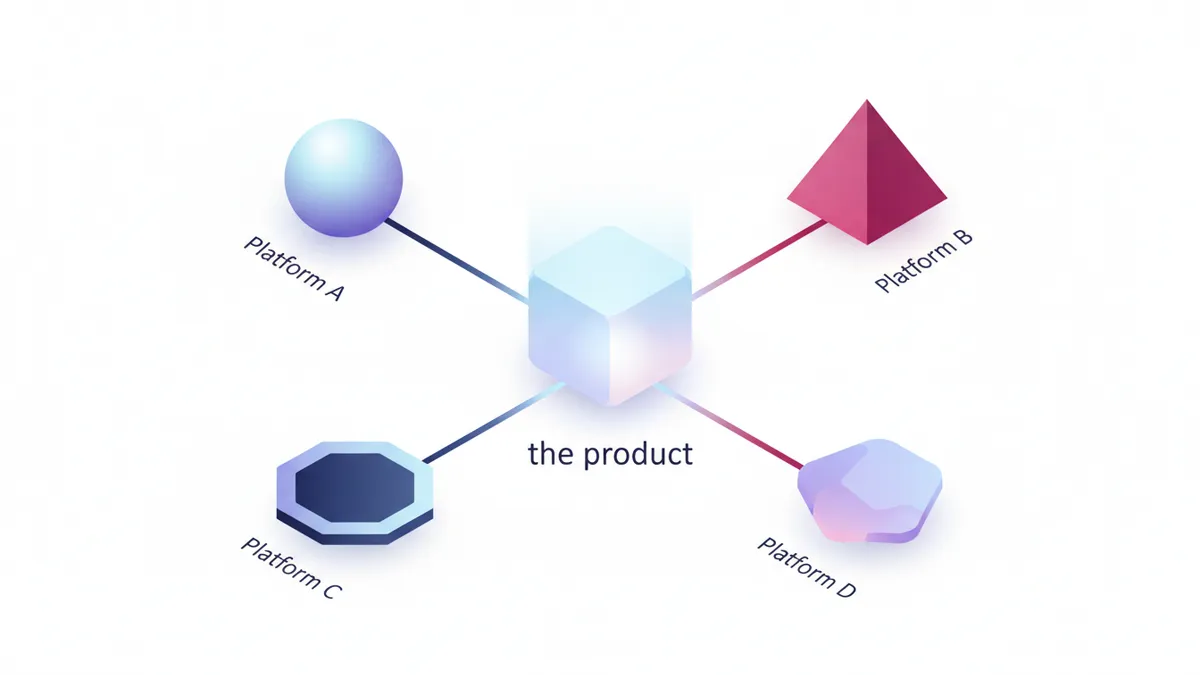
The answer isn’t more manual work. It’s smarter automation. Platform-adaptive automation generates unique content for each platform from a single product or brief.
Here’s the difference:
| Approach | What happens | Result |
|---|---|---|
| Cross-posting | Same caption, same image, same hashtags on every platform | Flagged as duplicate, reduced reach |
| Platform-adaptive | Unique caption, adapted format, platform-specific hashtags from one product | Treated as original, full distribution |
The workflow stays automated. You don’t write four different captions manually. Your automation tool creates them.
How this works with Brand Voice:
- You define your brand’s tone once. Casual, professional, playful. Whatever fits your store.
- You feed a product or topic into the tool.
- The AI generates platform-specific versions. A short, punchy TikTok caption. A story-driven Instagram caption. An SEO-rich Pinterest description. A link-forward Facebook post.
- Each version matches your voice. None of them are identical to each other.
IDEQO’s Brand Voice feature does exactly this. Set up your tone once and every AI-generated caption already sounds like your brand. Different words for each platform. Same brand feel everywhere. The algorithm sees original content because it is original content.
For the full rundown on what to automate vs. keep manual, check our social media automation guide for Shopify.
What should you automate on each platform?
Each platform rewards different behaviors. Your automation should match.
Automate: Scheduling, hashtag management, unique caption generation, analytics reporting.
Keep manual: Comment replies, Stories (these should feel spontaneous), community engagement.
Format: Use 4:5 portrait for feed. Write longer captions (Instagram rewards dwell time). 5-15 hashtags. Create content people want to DM to friends. Sends per reach is the new power metric.
TikTok
Automate: Scheduling at optimal times, caption generation, product-to-video workflows.
Keep manual: Audio selection (use original audio), trending content, duets and stitches.
Format: 9:16 vertical only. Keep videos under 30 seconds for completion rate. Include spoken keywords for search ranking. Focus on saves and shares, not likes.
Automate: Pin scheduling, SEO-rich description generation, product catalog syncing.
Keep manual: Board curation (strategic, not automated).
Format: 2:3 vertical pins. Write keyword-dense descriptions. Pinterest is a search engine, not a feed. Pins drive traffic for months. Pinterest is underrated for Shopify stores.
Automate: Post scheduling, link posts, product sharing from your catalog.
Keep manual: Group engagement, community responses.
Format: Square or landscape images. Shorter captions. Direct product links. 1-3 hashtags or skip them entirely.
Does platform-adaptive content actually perform better?
The data is clear. Platform-adaptive automation outperforms cross-posting on every metric that matters.
Buffer’s 1.2M post study found that AI-assisted posts had a 5.87% median engagement rate compared to 4.82% for human-only posts. That’s a 22% improvement. The key: AI posts adapted per platform outperformed generic cross-posts by an even wider margin.
Consistency compounds. Accounts that posted consistently for 20+ weeks saw 450% more engagement per post than sporadic accounts. But consistency means relevant, platform-native content. Cross-posting the same thing four times a day isn’t consistency. It’s noise.
AI adoption is near-universal. 96% of e-commerce professionals now use AI tools. 83% of marketing departments automate social posting. The question isn’t whether to automate. It’s whether your automation creates platform-native content or generic duplicates.
The time equation still works. Manual social media management takes 15-25 hours per week. With platform-adaptive automation, that drops to 2-5 hours. Same time savings as cross-posting. Dramatically better reach.
For product-specific content, captions matched to your Brand Voice convert better than generic templates. Personalization signals authenticity, which is exactly what 2026 algorithms reward.
How to update your automation strategy today
You can implement this in a single afternoon. Here’s the action plan.
Step 1: Audit your current cross-posting. Go to Instagram Insights and check reach per post for the last 90 days. If it’s declining while posting frequency stayed the same, cross-posting penalties are the likely cause.
Step 2: Set up Brand Voice. Define your brand’s tone in your automation tool. Casual or professional? Emoji-heavy or minimal? Playful or direct? IDEQO lets you configure this once. It becomes the foundation for all platform-specific content.
Step 3: Switch from “copy everywhere” to “adapt everywhere.” When you schedule a product post, generate unique captions for each platform. Same product, different messaging. Your Instagram caption tells a story. Your TikTok caption is three words and a hashtag. Your Pinterest description is keyword-rich.
Step 4: Adjust formats per platform. Stop posting square images to TikTok (it’s 9:16 only). Stop posting 60-second videos when 15 seconds gets better completion rates. Let your automation tool handle the reformatting.
Step 5: Batch create with AI. Block 2-3 hours once a week. Generate all your platform-specific content in one session. Load it into your content calendar and let it publish automatically. You’re not spending more time. You’re spending the same time more effectively.
Step 6: Monitor platform-specific metrics. Stop looking at total likes across platforms. Track these instead:
| Platform | Primary metric to watch |
|---|---|
| Sends per reach (DM shares) | |
| TikTok | Average watch time and completion rate |
| Click-through rate to your store | |
| Link clicks |
Step 7: Review and refine monthly. Which platform drives the most store traffic? Which content type gets the most saves? Double down on what works. Cut what doesn’t.
The tools that support platform-adaptive automation
Not every scheduling tool generates platform-specific content. Here’s what to look for:
- AI caption generation per platform. The tool should create different captions for Instagram, TikTok, and Pinterest from one brief.
- Brand Voice customization. AI output should match your brand’s tone. Not sound generic.
- Format adaptation. Automatic image resizing and format adjustment per platform.
- Shopify product sync. If you’re running a store, the tool should pull products directly from your catalog.
IDEQO handles all four. Connect your Shopify store, pull products from your catalog, generate platform-specific AI captions in your Brand Voice, and schedule with proper formatting per platform. The free plan includes 1 integration, 1 automation, and AI text and image generation. No credit card required.
For a detailed tool comparison, see our Buffer vs Hootsuite vs IDEQO breakdown for Shopify.
Ready to stop cross-posting and start automating smarter? Try IDEQO free and set up platform-adaptive content for your store in minutes. No credit card required.
Frequently Asked Questions
Does cross-posting hurt social media engagement in 2026?
Yes. Instagram now gives original content 40-60% more distribution than reposts. Accounts that repost 10+ times in 30 days get excluded from recommendations entirely. TikTok deprioritizes identical content that appears on other platforms.
How does Instagram detect cross-posted content?
Instagram's 2026 algorithm analyzes visual fingerprints, caption similarity, and posting patterns. Content posted identically across platforms or reposted from other accounts is flagged as non-original and receives significantly less reach.
Can you still automate social media if cross-posting doesn't work?
Absolutely. The shift is from identical cross-posting to platform-adaptive automation. Tools like IDEQO generate unique, platform-specific content from a single brief using Brand Voice. You automate smarter, not harder.
What's the difference between cross-posting and platform-adaptive automation?
Cross-posting copies one post to every platform unchanged. Platform-adaptive automation creates unique content per platform from the same product or topic. Same brand voice, different messaging tailored to each platform's algorithm and audience.
What does TikTok's algorithm prioritize in 2026?
Completion rate is the top signal. A 15-second video watched fully outranks a 60-second video watched halfway. Saves and shares outweigh likes. Original audio outperforms trending sounds. TikTok also analyzes spoken words and text overlays for search matching.