


Key Takeaways
- 87% of marketing professionals use AI for content in 2026, but only 33% have actually integrated it into their workflow.
- Consumer preference for AI content dropped from 60% to 26% since 2023. Unedited AI output is now a liability.
- AI content with human oversight performs significantly better than fully automated output.
- The highest-ROI uses: product descriptions, social captions, email copy, and content repurposing.
- Brand voice setup is not optional. Without it, every AI caption sounds like every other store selling your product.
- The winning workflow is AI for speed, human editing for trust.
Here’s the honest version of AI content for e-commerce in 2026.
87% of marketing professionals now use AI for content creation. That number sounds like a success story. But look closer: only 33% of businesses have actually integrated AI into their workflow in any meaningful way. The rest are experimenting, getting inconsistent results, and wondering why their AI captions don’t sound like them.
This isn’t a guide about AI’s potential. It’s about what it actually delivers for Shopify stores running lean, and where it quietly fails.
The reality check: what’s changed since AI content went mainstream
Two years ago, AI content was mostly about speed. Generate a product description in 10 seconds instead of 10 minutes. Ship more, faster. Early adopters saw real gains.
Now the dynamics have shifted.
Consumer skepticism has caught up with adoption. As of 2026, only 26% of US and UK consumers prefer AI-generated content, down from 60% in 2023. Audiences have gotten good at detecting the patterns: overly polished copy, no specific opinion, no real voice. Posts that could have come from any store selling your type of product.

73% of consumers say they can spot AI-generated marketing content. A significant portion report lower trust in the brand when they do.
This doesn’t mean AI content is useless. It means the bar for “good enough” has gone up. The stores getting results in 2026 are the ones using AI as a production layer, not a publish button.
What AI actually handles well for e-commerce
Start with the tasks where volume is the bottleneck, not creativity.
Product descriptions at scale. 47% of online sellers now use AI for product descriptions. For stores with dozens or hundreds of SKUs, this is the clearest win. AI generates solid first drafts: benefit-forward, keyword-aware, formatted for the channel. You review and adjust. The editing time is a fraction of the writing time. One merchant expanded from 200 to 1,200 SKUs over three months using AI-assisted descriptions without adding a single content writer.
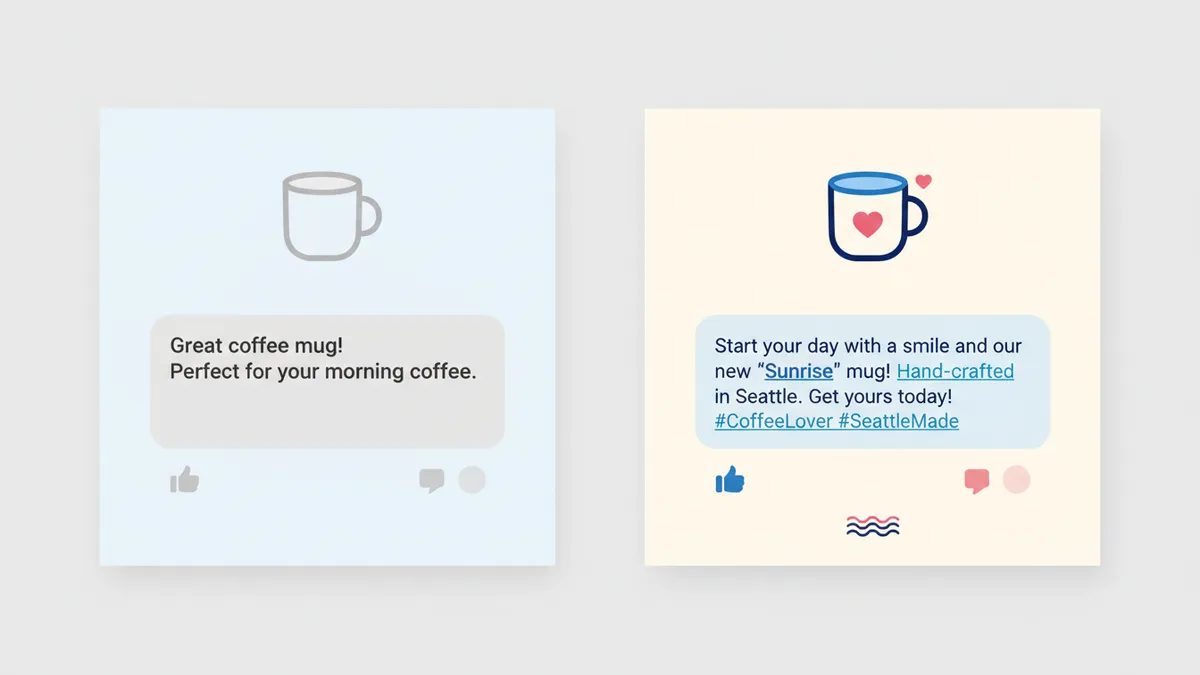
Social media captions. AI generates platform-specific captions from your product data in seconds. The catch is context. Without brand voice instructions in the prompt, you’ll get technically correct captions that sound like every other store. With brand voice context, captions come out close enough to require light editing rather than a full rewrite. Our free AI caption generator shows this directly: a generic prompt and a brand-aware one produce noticeably different results.
Email campaigns. AI handles email drafts reliably: subject line variations, promotional body copy, product feature callouts. One consistent finding across studies is that AI-assisted email campaigns show higher engagement than purely manual ones, largely because teams using AI can test more variations.
Content repurposing. This is underused. A 1,200-word blog post contains 8-10 distinct ideas. AI can systematically pull those ideas and adapt them for each platform: an Instagram carousel, a LinkedIn text post, an X/Twitter take. What used to take 90 minutes per post takes 20. See our full repurposing workflow for a step-by-step breakdown.
Ideation and outlines. AI eliminates blank page paralysis. Feed it your product niche, recent sales trends, and current platform formats and you’ll get 10 usable content angles in minutes. Not all 10 will be good. Three or four will be worth developing.
Where AI fails Shopify stores
Be honest about this before you commit to an AI workflow.
Generic output is the default, not the exception. AI’s default mode is a smooth, inoffensive average of everything it has read. That’s exactly what you don’t want for a brand trying to stand out. “Shop our summer collection” and “the perfect gift for anyone on your list” are AI-default. They’re also the captions nobody saves, shares, or clicks.

Personal story and community content can’t be automated. The “pack an order with me” video, the founder’s honest take on a bad product launch, the response to a trending audio. This content works precisely because it’s human and specific. AI can help you write the caption after you’ve shot the video. It can’t generate the story.
AI search optimization requires more than keywords. AI-powered discovery tools don’t just match keywords. They look for context, comparisons, use cases, and genuine answers to buyer questions. A product description optimized for traditional SEO won’t necessarily surface in Perplexity or ChatGPT’s shopping results. You need buying guides, comparisons, and problem-solution content. AI alone won’t build that architecture for you. See our Shopify SEO guide for what that actually looks like.
Quality decay without editorial review. Teams that skip editing see quality drop over time. AI picks up on what gets approved and starts anchoring to those examples. Mediocre examples included. Without a consistent editorial standard, the content gets progressively more generic. This is the hidden cost most “we use AI for everything” operations discover around month three.
The content types worth automating now
If you’re building an AI content workflow for your Shopify store, here’s where to start:
Automate immediately:
- Product caption generation for new arrivals
- Email subject line testing (run 3 variations per send)
- Blog post first drafts for evergreen topics
- Repurposing blog posts into platform-specific social content
Automate with oversight:
- Product descriptions (AI draft, human review for accuracy and voice)
- Promotional copy (AI structure, human adjustment for tone and timing)
- Hashtag strategy (AI suggestions, manual curation for niche relevance)
Keep manual:
- Founder and brand story content
- Community response and comment engagement
- Trend-reactive content requiring cultural context
- Any content that depends on a specific, authentic moment
The content calendar tool at /tools/content-calendar/ lets you map out which posts are AI-assisted and which need manual creation, so you can plan realistically instead of discovering mid-week that you have nothing scheduled.

How to maintain brand voice with AI
This is the part most guides skip. It’s also why most Shopify stores get mediocre results from AI content.
Brand voice isn’t a mood board. It’s a set of specific, trainable instructions.
Write down: three adjectives that describe how you write. Two phrases or words you use often. Two phrases you actively avoid. An example post you’d publish and one you’d delete. The type of customer you’re talking to and what they care about.
Feed that as context at the start of every AI prompt. Not once, not as an afterthought. Every time.
If you’re using a dedicated tool, look for Brand Voice functionality that saves this context and applies it automatically. IDEQO’s Brand Voice feature does this for Shopify stores specifically: you set it up once during onboarding and every generated caption reflects your tone rather than a generic ecommerce template.
The payoff is real. Consistent brand voice in social posts drives 23% more engagement on average, and accounts with consistent tone grow their following roughly 60% faster than those posting inconsistently. Those aren’t AI statistics. They’re brand consistency statistics. AI just makes consistency easier to maintain at scale.
The tools worth using in 2026
A quick honest breakdown:
For Shopify stores focused on social content: IDEQO is built for this specifically. Connects to your product catalog, generates brand-voice captions automatically, and schedules across platforms. Free plan covers one store and one automation.
For general social scheduling with AI assist: Buffer’s AI Assistant is solid for smaller teams. Clean interface, native Shopify connection, hashtag and posting time analytics.
For enterprise-scale multi-platform management: Hootsuite’s OwlyWriter handles volume well. Cost scales up quickly.
For product descriptions at scale: Shopify Magic handles basic drafts. For competitive differentiation, Claude or ChatGPT with a detailed brand prompt will outperform it, especially for products where copy quality matters.
For a detailed side-by-side comparison of scheduling tools, see Buffer vs Hootsuite vs IDEQO for Shopify.
What the data actually says about AI + human content
The clearest finding from 2026 data: AI content with meaningful human oversight significantly outperforms fully automated output. The gap is not minor.
The stores seeing the best results from AI are not the ones who’ve automated everything. They’re the ones who’ve automated the right things and protected the time and effort that makes their brand recognizable.
The workflow is simple: AI drafts, humans refine, brand voice guides both. Do that consistently and AI becomes a multiplier. Skip the human layer and you’ll spend the same hours you saved rewriting output that doesn’t sound like you.
Start with your product descriptions. Get the brand voice setup right. Then expand from there.
Frequently Asked Questions
Does AI content creation actually work for e-commerce stores?
Yes, with the right approach. AI works best as a first-draft tool for product descriptions, social media captions, and email copy. Where it fails is when stores publish AI output without editing for brand voice. Stores that use AI for speed and add human editing for quality consistently outperform those using either AI alone or spending hours writing everything manually.
What content types should Shopify stores use AI for in 2026?
Product descriptions, social media captions, email campaigns, blog outlines, and content repurposing are the highest-leverage uses. These tasks are repetitive, volume-dependent, and work well with AI when given brand context. Avoid using AI for content that requires personal story, genuine customer connection, or real-time cultural relevance. Those tasks still need a person.
Why does AI-generated content get lower engagement?
Consumer skepticism is at an all-time high. As of 2026, only 26% of US and UK consumers prefer AI-generated content, down from 60% in 2023. Audiences have learned to spot the patterns: overly polished language, no real opinion, no specific details. The fix is brand voice prompting plus meaningful human editing before publishing.
How do I keep my brand voice consistent when using AI for content?
Write a brand voice guide before you start: your tone descriptors, phrases you use and avoid, examples of posts you'd publish vs. posts you'd delete. Feed this as context in every AI prompt. Use tools like IDEQO's Brand Voice feature to train the AI on your store's specific communication style so captions consistently sound like you, not a template.
How much time does AI content creation actually save for Shopify stores?
Stores with an established AI workflow report saving 8-12 hours per week on content tasks. The biggest gains come from product caption generation, bulk product description writing, and repurposing one piece of content across platforms. Stores that skip the brand voice setup step spend that saved time on heavy editing and often end up ahead by less than they expected.